
A new scientific study involving UPWEARS researchers shows that the performance of a 3D-printed bio-based composite depends on more than just what the material is made of. How it is printed can significantly change its internal structure and its mechanical and thermal properties.
When developing more sustainable materials, choosing the right ingredients is only part of the challenge. The manufacturing process can also play an important role in determining how the final material behaves. This is particularly true for 3D printing, where parameters such as temperature, layer thickness, printing direction or the amount of material deposited inside a part can all affect its internal architecture.
A new study published in Polymer Testing, entitled “Thermal–microstructural–mechanical interactions in 3D-printed PLA/PHA-wood composites”, explores these relationships using a composite made from a PLA/PHA polymer matrix containing 30% recycled wood fibres.
Rather than looking at these effects separately, the researchers followed the material across the entire printing process, linking thermal conditions during deposition to the internal structure of the printed part and, ultimately, to its mechanical and thermal performance. Their results highlight an important principle: the same bio-based material can be printed to favour either mechanical performance or thermal insulation.
What happens during 3D printing?
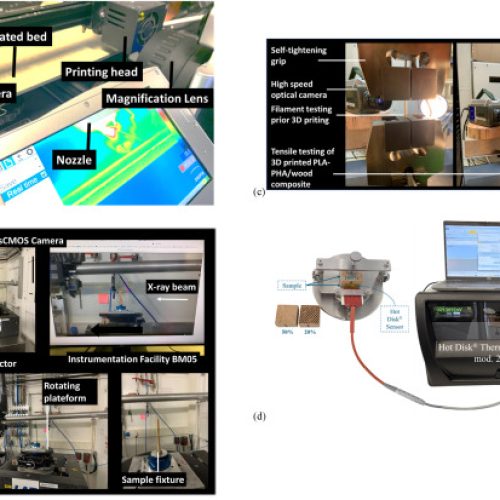
The material was processed using fused filament fabrication, or FFF, one of the most widely used forms of 3D printing. A filament is fed into a heated nozzle, where it softens before being deposited onto a platform. The printer follows a programmed path, depositing one line after another and one layer on top of the previous one until the complete object is formed.
Each newly deposited filament is hot. It begins to cool as soon as it leaves the nozzle, while the next layers bring additional heat to the structure. The temperature reached by the material, the speed at which it cools and the contact between neighbouring filaments all influence how well the different layers bond together. This means that printing parameters matter.
The printing temperature affects how easily the material flows and how neighbouring layers connect. Layer height changes the geometry of the deposited material and its contact with previous layers. Printing orientation determines how the filaments are positioned relative to the forces that the final part will experience.
Among the conditions tested, a layer height of 0.2 mm produced the most continuous deposition, illustrating how even a seemingly small printing parameter can influence the final microstructure.
The infill rate is a printing setting that controls how densely the interior of a part is filled. A nominal infill of 100% produces a dense deposition pattern, although pores can remain within and between deposited strands. A 20% infill deliberately introduces larger internal spaces.
These differences can have a major impact on the properties of the final object.
Looking inside the printed material
To understand these effects, the researchers needed to look beyond the surface of the printed samples. First, an infrared camera was used to follow temperature changes while the material was being deposited. This made it possible to observe the thermal cycles experienced by the filament during printing and how heat accumulated or dissipated as successive layers were added.
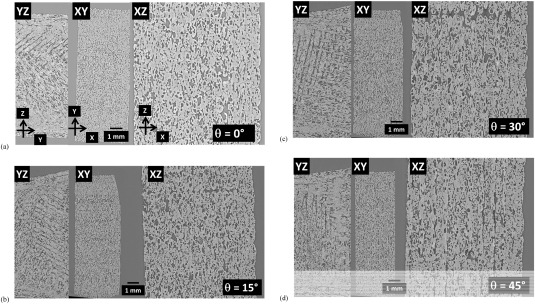
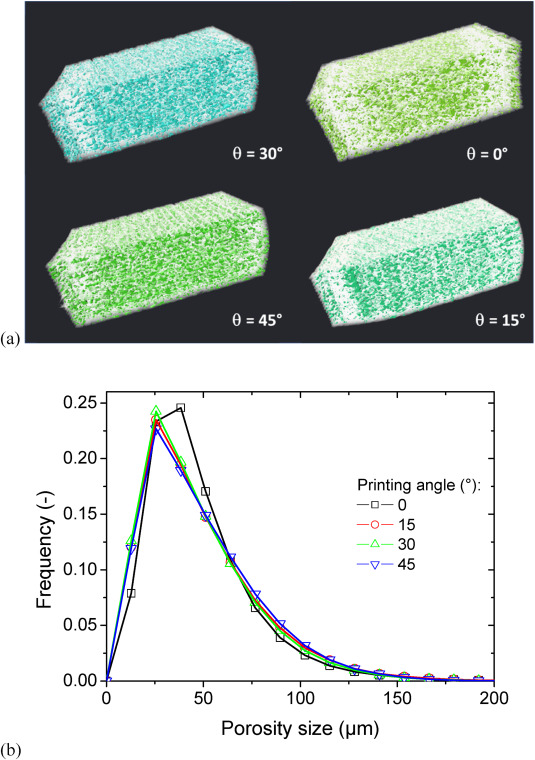
The internal structure was then examined using synchrotron X-ray microtomography. Similar to a medical CT scan, X-ray tomography makes it possible to reconstruct the inside of a material in three dimensions without cutting it open. At a synchrotron facility, the high-intensity X-ray beam allows researchers to observe very small structural details. The images revealed pores and voids created during the printing process. The images revealed porosity already present in the original filament, as well as additional voids between deposited strands and layers. In the printed structures, average porosity was around 22-33%, depending on printing orientation. The printing angle determines how the deposited strands are aligned relative to the tensile loading direction.
The printed object is not simply a solid block of composite. Its internal structure reflects the path followed by the printer. The researchers then combined these observations with tensile tests to measure mechanical behaviour and with thermal measurements to determine how easily heat travelled through the printed structures.
Balancing strength and insulation
Pores reduce the amount of solid material available to carry loads and can act as sites for stress concentration and damage initiation. However, air-filled spaces can also reduce heat transfer, making porosity useful when thermal insulation is the objective. Porosity is therefore not simply a defect to eliminate: its effect depends on what the printed part is designed to do. They reduce the amount of material available to carry the load and can make it easier for cracks or deformation to develop.
The best overall combination of stiffness and tensile strength was obtained at 100% infill with a 0° printing angle, where filament alignment favoured efficient load transfer.
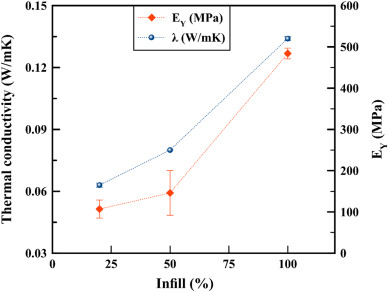
Under these conditions, the material reached a Young’s modulus of approximately 484 MPa and a tensile strength of 19.7 MPa. But when thermal insulation is the objective, empty space can become an advantage. Air conducts heat much less effectively than the solid composite. By lowering the infill rate, the printed structure contains more air-filled space, making it more difficult for heat to travel through the material.
The researchers measured thermal conductivities ranging from approximately 0.06 to 0.13 W/m·K, depending on infill density. At 20% infill, the structure reached a thermal conductivity of around 0.06 W/m·K, highlighting its potential for thermal insulation applications.
Increasing the amount of material inside the printed structure improves stiffness and mechanical resistance, while decreasing it creates a lighter and more porous architecture with better insulating properties.
The material itself has not changed. What changes is its architecture.
Why this matters for UPWEARS
This study provides a clear illustration of a key relationship in material science: process → microsture → properties. By combining observations during printing, 3D imaging and performance performance testing, the researchers showed how manufacturing conditions modify the internal architecture of a material and, in turn, its final behaviour.
This approach is closely related to the work carried out within UPWEARS, where understanding the links between processing conditions, material structure and final performance is essential for developing reliable and efficient bio-based materials.
The study also shows the potential of additive manufacturing as more than simply a shaping technique. By controlling the internal architecture of a part, 3D printing can become a way of tailoring the function of a material.
The same bio-based composite could therefore be designed as a denser, mechanically resistant component in one application, or as a lighter, thermally insulating structure in another.
Key takeaways
- The composite combines a PLA/PHA matrix with 30wt% recycled wood fibres.
- Printing conditions shape the internal architecture of the final part.
- Dense structures provide better mechanical performance.
- More porous, low-infill structures reduc thermal conductivity
- 3D printing can therefore tailor the same material architecture towards different functional needs.
Publication details
Title: Thermal–microstructural–mechanical interactions in 3D-printed PLA/PHA-wood composites
Journal: Polymer Testing, Volume 161, 109266 (2026)
Authors: Sofiane Guessasma, Sofiane Belhabib, Jaianth Vijayakumar, Yassine Rahib, Abdullah Altin and Elodie Boller
Read the full open-access article: https://www.sciencedirect.com/science/article/pii/S0142941826001832