Hoël Tricou Le Pennec explores plant fibre durability within UPWEARS scope.
Stepping into a new research culture
PhD mobilities are first and foremost human and scientific journeys. For Hoël Tricou Le Pennec, spending three months at the University of Cambridge was an opportunity to step outside his usual research environment and immerse himself in a new academic culture. Working closely with his co-supervisor and the CNMI research team, he explored alternative approaches, accessed advanced experimental facilities and confronted his own research questions with fresh perspectives. This mobility was not only about advancing scientific work, but also about learning differently, through new teaching formats, interdisciplinary exchanges and daily interactions within a highly stimulating and international research setting.
This mobility reinforced my belief that interdisciplinarity and diversity are essential drivers of academic fulfilment and innovation.
— Hoël Tricou Le Pennec, UPWEARS PhD candidate
An interdisciplinary academic journey
Hoël’s academic path reflects a strong curiosity for materials, design and interdisciplinary research. He began his studies in France with a CPGE in Physics and Chemistry in Limoges, before joining a generalist engineering school in Alès. There, he specialised in the ECOMAP department (Eco-Conception, Materials and Properties), where he discovered the research world and developed a strong interest in sustainable materials. This first experience led him abroad, with a research internship at the University of Vienna within the Polymer and Composite Engineering (PACE) team, where he worked as a PhD assistant. Keen to further broaden his perspective, Hoël then pursued a double degree in Integrated Design of Engineering at Keio University in Japan, combining selective coursework and a master’s thesis. These international and interdisciplinary experiences naturally led him to apply for (and join!) the UPWEARS PhD programme.
Within UPWEARS, Hoël’s work focuses on a central challenge for sustainable textiles: understanding how plant-based fibres respond to environmental stresses to extend their lifetime and usage. His PhD research investigates the durability of textile plant fibres when exposed to ultraviolet radiation, shedding light on degradation mechanisms that directly affect performance and longevity. Beyond the scientific questions, Hoël’s work is driven by a broader vision of textiles: one that encourages rethinking consumption habits, valuing materials derived from local resources and exploring alternative ways of designing and using textile products. Deeply committed to interdisciplinary collaboration, he seeks to build bridges between scientific fields and to make research knowledge accessible and transferable to a wide audience, while maintaining a strong connection between academic research and societal challenges.
Why Cambridge? A natural choice for UPWEARS
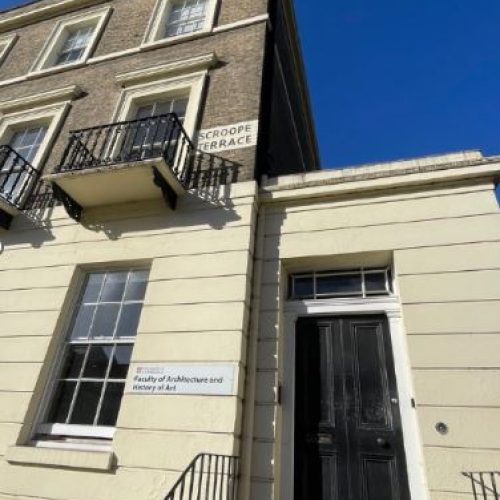
The University of Cambridge was a natural destination for this mobility, both scientifically and academically. Home to Hoël’s co-supervisor, Dr Darshil U. Shah, and an associated partner of UPWEARS, Cambridge offered a unique environment to deepen collaboration while stepping into a new research culture. Based within the Department of Architecture, Hoël joined the Centre for Natural Material Innovation (CNMI), a highly interdisciplinary team bringing together architects, materials scientists and engineers working on natural materials across scales. This setting fostered rich exchanges with researchers and students from diverse backgrounds, broadening his perspective on research and innovation. Beyond laboratory work, Cambridge also provided Hoël with access to high-level training, including academic writing workshops.
🔍 Research at a glance
|
Focus
|
Photo Chemistry of plant fibres |
|
Materials
|
UV Aged Flax fibres |
|
Techniques |
Raman Spectroscopy, Atomic Force Microscopy coupled with Infrared, fluorescence microscopy, X-ray Diffraction |
|
Host team |
CNMI – Centre for Natural Material Innovation |
Exploring fibre degradation at the microscale
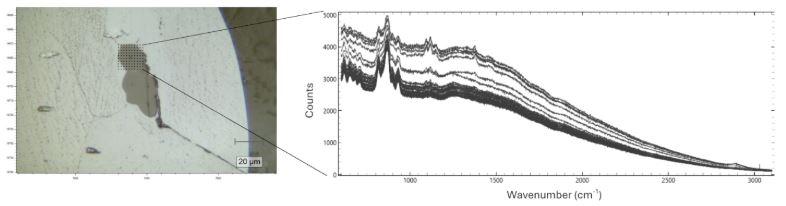
During his mobility at Cambridge, Hoël’s research focused on the photochemistry of plant fibres, with investigations conducted at fibre cell wall scale. The aim was to better understand how environmental stresses, particularly ultraviolet radiation (UV), affect the chemical and structural integrity of flax fibres. Therefore, with the help of several expert teams, several characterisation techniques based upon fibres’ interactions with light were mobilised to answer some specific scientific questions. On one hand, fibres’ outer and inner components were studied to determine if UV caused homogeneously diffused chemical alteration or not. On the other hand, the consequences of these chemical changes on its physical properties (crystallinity and fluorescence) were studied. Alongside experimental work, Hoël actively collaborated with CNMI researchers, including fellow PhD students and UPWEARS partners, while also strengthening his scientific writing skills through dedicated training courses at Cambridge.
What this mobility changed: scientifically and personally
This mobility proved to be a deeply formative experience, both scientifically and personally. Beyond acquiring advanced technical skills in specific tools, Hoël also developed a broader understanding of research methodologies and collaborative working practices. Daily interactions within an interdisciplinary and international team highlighted the importance of communication, collective thinking and effective collaboration in scientific work. The opportunity to take time between experimental sessions, reflect on results and receive progressive feedback strengthened his confidence in pursuing an in-depth, thoughtful research approach. Being immersed in a research environment markedly different from his home institution allowed Hoël to gain greater perspective on his work, his career and his personal aspirations. This experience reinforced his belief that interdisciplinarity and diversity are essential drivers of academic fulfilment and innovation. Eventually, Hoël’s life in Cambridge also consisted of involving himself in the vibrant community and civic life of the city, from learning to row on the River Cam to appreciating the tranquillity of colleges’ libraries.
I would like to warmly thank my supervisors, Dr Alain Bourmaud and Dr Darshil U. Shah, for their guidance and support throughout this mobility. I am also very grateful to the entire CNMI team for their kindness and continuous support during my stay in Cambridge. Finally, I would like to acknowledge the European Union for funding this mobility through the UPWEARS project, as well as my doctoral school for the three-month mobility grant that made this experience possible.
— Hoël Tricou Le Pennec, UPWEARS PhD candidate