
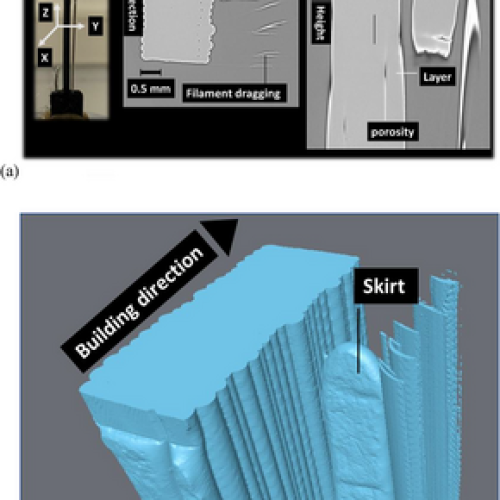
3D printing may look like a simple process: a filament is melted and deposited layer by layer until an object takes shape. But inside the material, much more is happening. Every time the printing nozzle passes, the material is heated, pressed, cooled and reheated by the following layers. These repeated thermal and mechanical cycles cause tiny expansions and contractions that can influence the internal structure and, ultimately, the quality of the printed part.
A new study involving UPWEARS researchers takes a closer look at these hidden phenomena during the 3D printing of PLA. By monitoring temperature and deformation directly during printing, the researchers explored when these internal strains appear, how quickly heat moves through the material and how printing parameters can help control them.
3D printing: more than stacking layers
The study focuses on Fused Filament Fabrication, or FFF, one of the most common 3D printing techniques.
A polymer filament is fed into a heated nozzle, where it softens before being deposited onto a printing platform. The nozzle follows a programmed path, placing one thin line of material after another. Once a layer is complete, the printer moves upwards and starts the next one.
This continues until the complete object has been built.
It sounds straightforward, but each newly deposited filament interacts with both the nozzle and the material already underneath it.
The nozzle applies mechanical pressure as it deposits the molten polymer. At the same time, the hot filament transfers heat to previous layers. The material expands as its temperature rises, then contracts as it cools.
Because this process happens again and again throughout printing, the finished part carries the history of all these successive cycles.
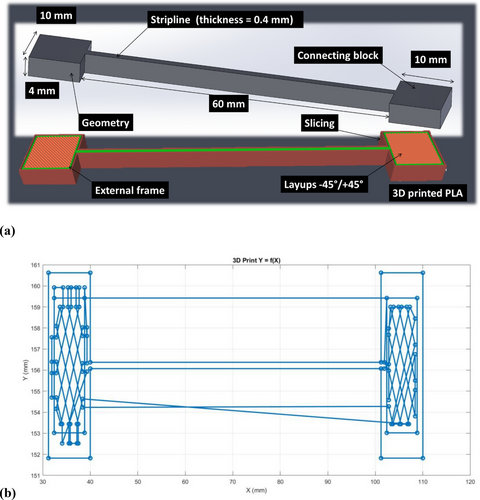
Heating, cooling and hidden stresses
If expansion and contraction are not uniform throughout the printed part, they can create internal strains and residual stresses.
Residual stresses are forces that remain trapped inside a material even after the manufacturing process is over. In a 3D-printed part, they can contribute to defects such as warping, cracking or separation between layers, known as delamination.
Understanding where these stresses come from therefore means looking closely at what happens immediately after the filament leaves the nozzle.
The study shows that two effects occur simultaneously.
First, the nozzle physically presses on the material during deposition. Second, the repeated heating and cooling cycles cause the polymer to expand and contract.
The result is a constantly changing local mechanical state, even while the printed object appears to be simply growing layer by layer.
How can researchers see what happens during printing?
Observing such tiny and rapid changes requires several complementary techniques.
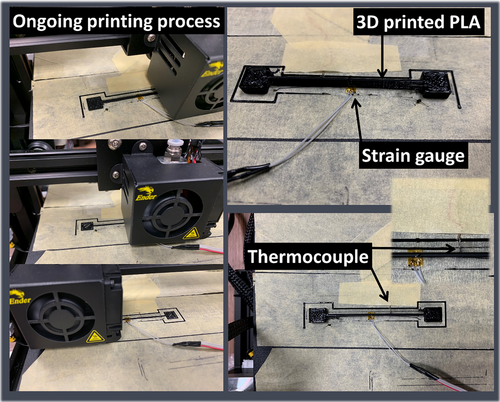
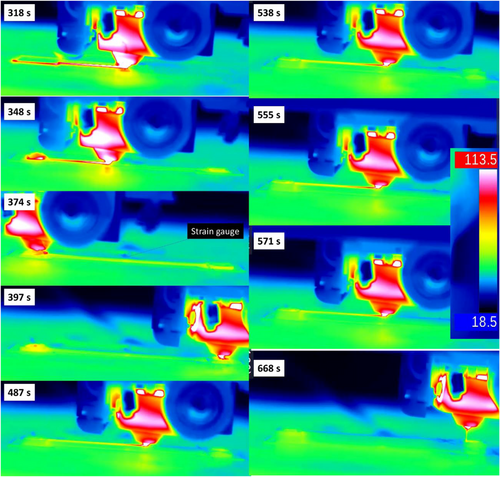
The researchers used a high-resolution infrared camera to follow temperature changes during printing. This made it possible to see the hot filament as it was deposited and to track how quickly the heat spread and disappeared.
They also used strain gauges, small sensors capable of detecting extremely slight deformation. Placed within the experimental setup, these sensors measured how the material expanded or contracted as the nozzle passed and new layers were added.
Temperature measurements were used alongside them to distinguish deformation caused by heat from the mechanical strain generated during deposition.
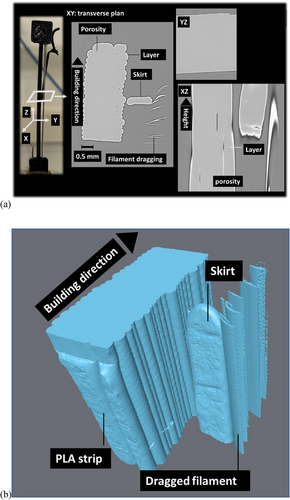
Finally, synchrotron X-ray microtomography was used to examine the printed structure in three dimensions.
Similar to a highly detailed CT scan, this technique allows researchers to look inside the material without cutting it open, revealing the shape of deposited filaments, their interfaces and very small pores created during printing.
Together, these tools provided different pieces of the same puzzle: what the material experiences during printing, and what remains inside it afterwards.
Why the first layers matter
One of the clearest findings concerns the beginning of the printing process.
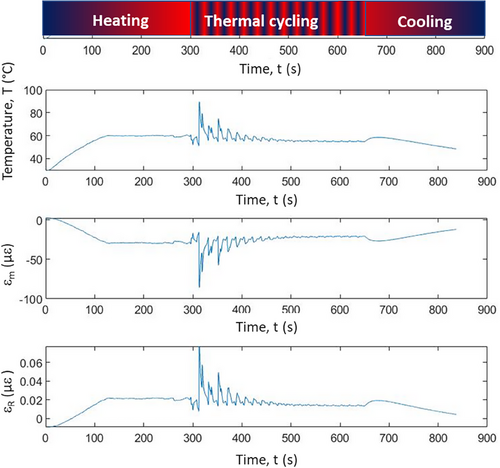
The researchers found that the largest variations in mechanical strain mainly occurred during the first five deposited layers.
These first layers are particularly important because they form the interface between the printed object and the heated platform. At this stage, the material is exposed to strong temperature differences while also being compressed by the nozzle as successive layers are added.
The measurements also show how fast and localised these thermal changes can be.
When the nozzle passes over a specific area, the temperature rises almost immediately. Once it moves away, the material begins cooling rapidly. The initial cooling rate measured in the study reached approximately 130°C per second, before slowing as the heat dissipated.
At the same time, the heat generated at the surface did not remain confined to the newest layer. Thermal imaging showed that it could penetrate approximately 4 mm into the PLA structure.
A single pass of the nozzle can therefore temporarily affect several previously deposited layers.
Can printing parameters reduce these stresses?
These internal changes are not unavoidable. The study shows that adjusting the printing conditions can help control them.
One particularly important parameter is the temperature of the printing bed.
The researchers compared different conditions and found that increasing the bed temperature to 80°C significantly reduced fluctuations in strain.
The explanation lies in the temperature difference between the newly deposited hot material and the layers underneath it.
When the printing bed is warmer, this difference becomes smaller. The material therefore experiences less abrupt heating and cooling, reducing the thermal gradients that contribute to expansion and contraction.
In the experiments, raising the bed temperature to 80°C reduced strain fluctuations to around 0.009 – 0.010 µε.
Other parameters, including printing temperature, printing speed and material flow rate, also affected the thermal and mechanical behaviour observed during deposition.
This highlights an important point: printing parameters do more than determine how quickly or accurately an object is produced. They also influence what happens inside the material while it is being built.
Why this matters for UPWEARS
Developing more sustainable materials is not only about selecting alternative raw materials.
It is also necessary to understand how those materials behave during manufacturing and how processing conditions affect the properties of the final product.
Within UPWEARS, additive manufacturing is one of the technologies being explored to develop new solutions using more sustainable materials.
This study provides a methodology for looking directly at the relationship between printing conditions, thermal and mechanical behaviour, internal structure and final material quality.
For now, the experiments were conducted using PLA, a widely used polymer that provides well-controlled conditions for studying these mechanisms.
But the next step brings the work even closer to UPWEARS. The researchers plan to extend the same methodology to PLA blends incorporating textile residues, investigating how these new formulations affect melting behaviour, mechanical response and strain during printing.
Understanding these interactions will help researchers adapt manufacturing conditions to new materials rather than simply applying existing printing parameters to them.
Ultimately, better control of what happens during deposition could help produce more reliable parts while limiting internal defects and making better use of sustainable feedstocks.
Key takeaways
- Fused Filament Fabrication involves much more than simply stacking layers: the material is repeatedly heated, cooled, compressed and reheated during printing.
- These thermal and mechanical cycles can generate internal strains and residual stresses that may affect the quality of the final part.
- Infrared imaging, strain sensors and synchrotron X-ray tomography can reveal what happens during and after filament deposition.
- The largest strain variations were mainly observed during the first five deposited layers.
- Heat from the nozzle can penetrate around 4 mm into the printed PLA, while cooling immediately after deposition can be extremely rapid.
- Increasing the printing bed temperature to 80°C reduced strain fluctuations by limiting thermal gradients.
- Better understanding these mechanisms can help optimise additive manufacturing parameters and produce more reliable printed parts.
- The methodology will next be extended to PLA blends containing textile residues, directly connecting this work with UPWEARS’ research on more sustainable materials.
Publication details
Title: Exploring Thermal and Mechanical Strains During Laying Down Process in Fused Filament Fabrication
Journal: Macromolecular Materials and Engineering, Volume 311, Issue 3, e00331
Authors: Boubakeur Mecheri, Jaianth Vijayakumar, Elodie Boller and Sofiane Guessasma
Read the full open-access article: https://onlinelibrary.wiley.com/doi/10.1002/mame.202500331

