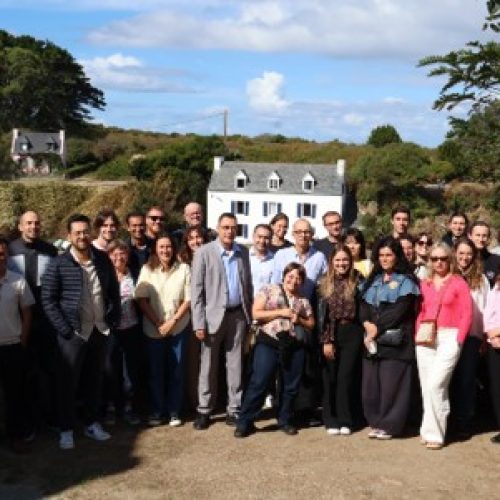
UPWEARS partners and guests gathered in Lorient and on the island of Groix for four days of scientific talks, laboratory visits and discussions about the project’s progress.
How can researchers compare two plant fibres when even fibres from the same plant can behave differently? This question opened UPWEARS Workshop #3, held on 15 September 2026 at Université Bretagne Sud in Lorient. The workshop brought together researchers, technical experts and other participants to examine mechanical characterisation at every scale, from the plant cell wall to the finished textile.
UPWEARS Workshop #3 – Lorient, France – 15 September 2026
The morning programme took participants through the successive stages of measurement. Christophe Baley (UBS) discussed tensile testing of elementary fibres and the variability it reveals. Olivier Arnould (Université de Montpellier) then focused on the mechanical characterisation of plant cell walls. Thomas Jeannin (UMLP) explored how tensile test results are processed, before François Boussu (ENSAIT) brought the discussion to yarns and textiles.
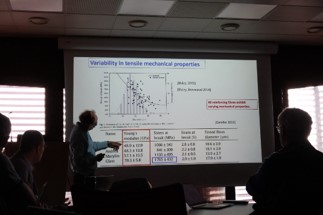
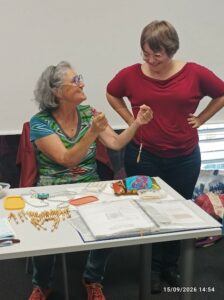
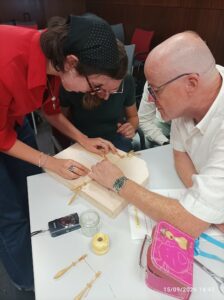
In the afternoon, small-group laboratory visits brought these questions closer to experimental practice. Participants explored characterisation methods and equipment, including microscopy, sample preparation and mechanical testing. The visits offered a chance to continue discussions sparked by the talks and see how different approaches can complement one another. A Breton lace-making workshop brought a local touch to the day, giving participants a chance to discover the region’s textile heritage.
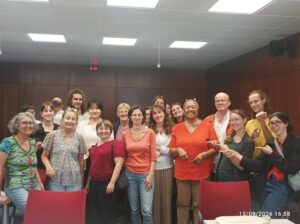
UPWEARS 5th Consortium Meeting – Groix, France – 16-18 September 2026
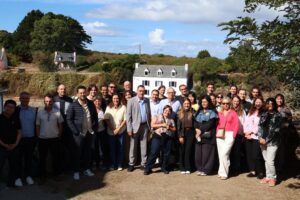
After the workshop, the UPWEARS partners travelled to the island of Groix for the project’s 5th consortium meeting, held at the Port-Lay conference centre. The change of setting gave partners time to step back from individual experiments and look at how their work fits together.
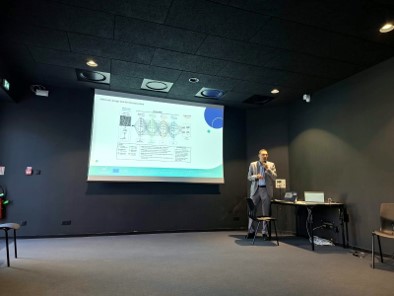
The meeting opened with a welcome from Alain Bourmaud (UBS) and project updates from coordinator Sofiane Guessasma (INRAE), before the teams presented progress across the different UPWEARS work packages.
Digital tools and smart textile development
The first technical session focused on WP5 and the development of digital tools for textile processes and products. Alongside an overview of WP5 progress, Qunyue Liang (INRAE) presented her PhD work on robotic fabric handling, combining simulation, computer vision and AI-based control to enable robots to grasp, reposition and align flexible textiles. Alaeddine Zereg (INRAE) presented numerical work on the design of the shoulder shock-absorption pad for the cycling outfit, using impact simulation and topology optimisation to explore lighter protective structures.
The meeting then moved to WP4 on sustainable e-textile design and production. Gilda Santos (CITEVE) presented overall progress towards the smart cross-country biking suit, covering hybrid fabrics, sensor integration, bio-inspired solutions and garment design.
Filipa Mendes (CITEVE) presented the selected woven fabrics, their functional distribution across the different parts of the outfit and the first garment mock-ups. Ilona Anesa presented her work on bio-based woven fabrics for sportswear, investigating how weaving parameters influence properties such as stretchability, breathability and durability, including the exploration of kirigami-inspired patterns to provide additional stretch.
From bio-based materials to textile performance
The afternoon continued with WP3 on the formulation and functionalisation of bio-based materials. Johnny Beaugrand (INRAE) provided an overview of progress within the WP, followed by presentations from Marc Rouchon and Théo Le Gagne (INRAE) on their ongoing research. The work is supporting the development and functionalisation of natural fibres for UPWEARS, with upcoming activities also extending testing to hemp fibres.
WP6 then focused on the performance, reliability and durability of the materials developed in the project. Alessia Melelli (SOLEIL) presented advanced imaging work using synchrotron facilities to investigate flax fibres at different scales, including the effects of ageing and bleaching treatments.
Delphine Quereilhac (UBS) presented an experimental approach combining tensile testing and second harmonic generation microscopy to observe how the internal cellulose structure of flax fibres reorganises as they are stretched.
Louise Le Gall (BSI Scion) presented work on giving flax fibres a second life through additive manufacturing, processing recycled fibres into bio-based composite materials for 3D printing and investigating how treatment, ageing and printing conditions influence their properties.
The first day concluded with a dedicated discussion on interactions between work packages, helping partners connect developments across materials, textile manufacturing, digital tools and performance.
Recycling, circularity and sustainability
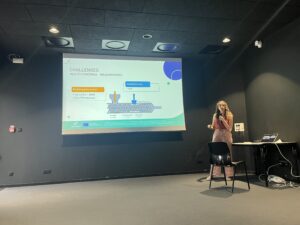
The second day opened with WP7 on recyclability, circularity and additive manufacturing. Chaimaa Jafrane (INRAE) presented her PhD work on the functionalisation of flax fibres with magnetic particles, exploring a route that could facilitate their recovery at the end of the textile’s life.
Sofiane Guessasma (INRAE) presented progress on transforming textile residues into new feedstock for additive manufacturing, while Louise Le Gall (BSI Scion) presented complementary work on converting recycled flax fibres and polyester textile waste into 3D-printable materials.
WP8 then turned the discussion towards the wider sustainability of the UPWEARS solutions. Lola Eelen and Fatemeh Taheri (KU Leuven) presented progress on environmental, economic, social and circularity assessments. Preliminary Life Cycle Assessment models are being developed for several parts of the UPWEARS value chain to identify environmental hotspots and opportunities for process optimisation.
Their presentation also covered circular design strategies for e-textiles and the first results of the project’s consumer acceptance study. Based on 74 responses, the study highlighted perceived usefulness and appearance quality as important drivers of purchase intention, while sustainability provides additional value.
Preparing the next steps of UPWEARS
The programme then moved to WP2, with Garance Renoncourt (Bioeconomy For Change) presenting the latest communication, dissemination and exploitation activities, followed by WP1 discussions led by Sofiane Guessasma (INRAE) on project management, administrative and financial monitoring and exchanges with the Project Officer.
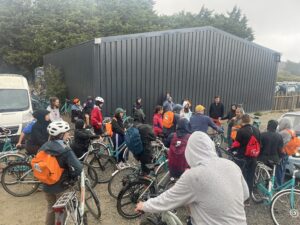
After the morning sessions, partners swapped the meeting room for bicycles and spent the afternoon exploring the island of Groix together. The cycling activity offered a more informal way to discover the island while continuing exchanges between consortium members outside the technical sessions.
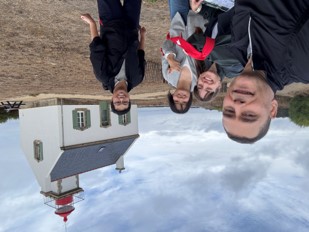
The final morning was dedicated to wrapping up the project’s first reporting period, revising the technical report and preparing RP2. Partners also had a Q&A session with HADEA Project Officer Cristian Iacob and Project Financial Officer Carmen Cano Siles before agreeing on the next actions, responsibilities and future meetings.
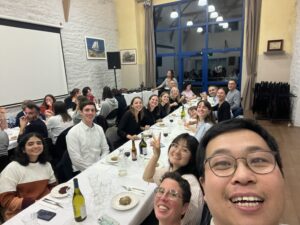
Thank you to UBS for hosting the workshop and consortium meeting, to the speakers for sharing their expertise, and to everyone who took part inthe discussions in Lorient, on Groix and online. The exchanges will continue in Auckland in 2027, when UPWEARS partners gather for the next workshop and consortium meeting.