
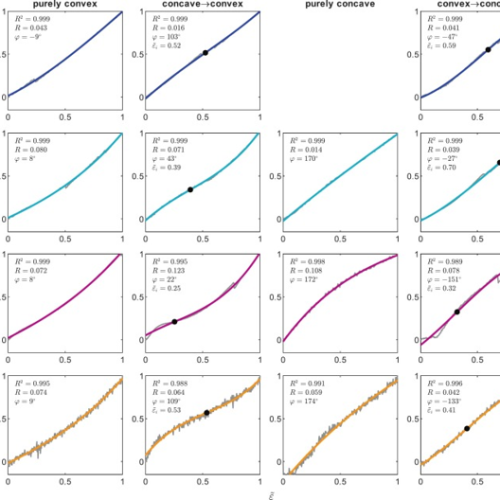
A new study involving UPWEARS researchers introduces a method to uncover information hidden in the way plant fibres respond to stretching.
How much force can a plant fibre withstand before it breaks? This is an important question when developing bio-based materials. But strength alone does not tell the whole story. The way a fibre stretches also provides clues about its internal structure.
A new scientific publication, resulting from a collaboration between Tampere University and Université Bretagne Sud, entitled “Quantitative non-linearity analysis of single plant fiber tensile curves using Legendre harmonic decomposition”, presents a method to capture this information. The study contributes to UPWEARS WP6 – Performance reliability and durability development
Looking beyond strength and stiffness
During a tensile test, a fibre is pulled until it breaks. Researchers record the relationship between the stress applied and the resulting strain, meaning how much the fibre stretches relative to its original length.
For a material with a linear response, this relationship follows a straight line: increasing the stress produces a proportional increase in strain. Plant fibres often behave differently, producing curved responses.
These curves reflect the fibres’ complex internal organisation. Inside their cell walls, tiny strands of cellulose, called microfibrils, are embedded in other natural compounds. As the fibre stretches, these microfibrils can progressively realign, changing its response to loading.
Understanding the shape of the curve therefore reveals information that conventional strength and stiffness measurements can miss.
Turning curve shapes into measurable information
Plant fibres vary naturally, even within the same plant. Differences in their structure, maturity and defects can all influence their mechanical behaviour.
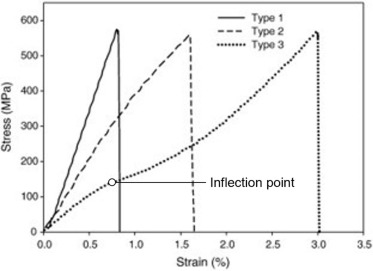
Researchers commonly classify tensile curves into three broad categories. However, this approach relies partly on visual judgement and can overlook subtle differences between fibres.
The new method replaces these broad categories with numerical descriptions. First, each curve is rescaled to a common reference, allowing its shape to be examined independently of the fibre’s stiffness, strength and strain at failure.
A mathematical technique called Legendre harmonic decomposition then translates the curve into three indicators. These describe how far the response departs from a straight line, the type of curve, and where its curvature changes.
This provides a consistent basis for comparing many individual fibres and analysing the differences statistically.
What did the comparisons reveal?
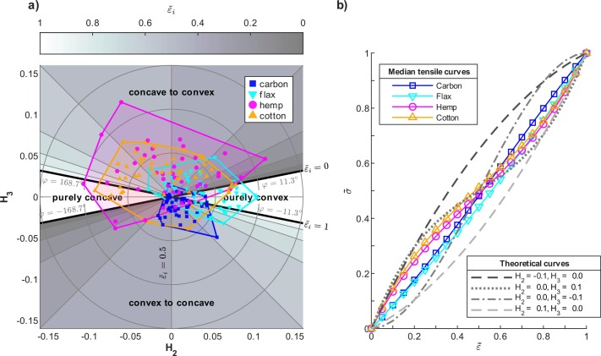
b: Median tensile curves for carbon, flax, hemp and cotton fibres, alongside theoretical curve shapes.
The researchers demonstrated the method on flax, hemp and cotton fibres, using carbon fibres as a reference.
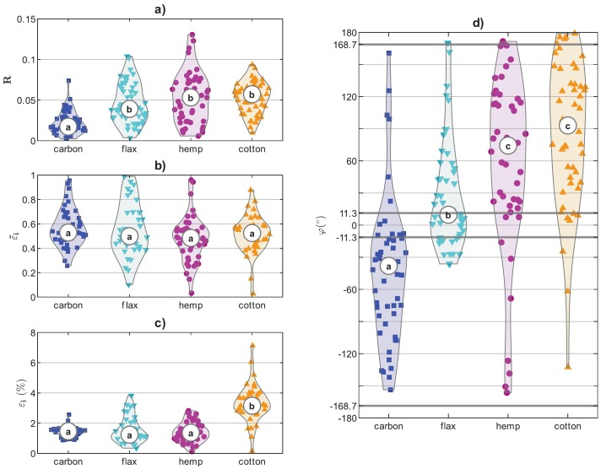
Carbon fibres showed a response much closer to a straight line than the plant fibres. The method also distinguished flax from hemp and cotton through differences in curve shape.
Cotton stood out through the position of its change in curvature. This finding is consistent with its larger microfibril angle: its cellulose microfibrils require more stretching before realigning.
Together, these results show that the indicators can distinguish behaviours consistent with known differences in fibre structure.
Supporting the development of bio-based materials
For UPWEARS, understanding variability is an important part of developing plant-based textiles and materials.
By making curve shapes measurable, this approach could help researchers investigate how fibre structure, processing and environmental conditions influence mechanical behaviour. It also supports more systematic comparisons of plant fibres intended as reinforcements in composites.
The aim is to learn more from each tensile test, helping researchers better understand how natural fibres perform.
Publication details
Title: Quantitative non-linearity analysis of single plant fiber tensile curves using Legendre harmonic decomposition
Journal: Composites Part A: Applied Science and Manufacturing
Authors: Jason Govilas, Alain Bourmaud, Essi Sarlin and Delphine Quereilhac
Read the full open-access article : https://www.sciencedirect.com/science/article/pii/S1359835X26005798#s0010