
New UPWEARS research reveals how industrial bleaching can strenghten flax fibres from the inside out
Bleaching is a common step in textile processing, used to clean natural fibres and prepare them for spinning and dyeing. But what happens inside flax fibres during this treatment? And how does it affect their performance?
A new scientific publication resulting from a collaboration between Université Bretagne Sud, the SOLEIL Synchrotron and Tampere University has been published in Composites Part A. The study entitled “Unveiling the impact of chemical bleaching on flax fibres: from cellulose reorganisation to mechanical performance” contributes to WP6 – Performance reliability and durability development of UPWEARS.
Supporting the development of greener textile processes
Within UPWEARS, researchers are developing an innovative and environmentally friendly bleaching process for flax fibres. Before introducing this new solution, it is essentiel to understand how the conventional bleaching methods currently used by industry affect fibre structure and performance.
This research therefore serves as an important benchmark for evaluating future sustainable alternatives developed within the project.
Looking beyond the fibre surface
To investigate the effects of bleaching, scientists compared raw flax fibres with conventionally bleached fibres using a combination of advanced analytical techniques.
The fibres were examined across multiple scales, from their visible surface down to their microscopic internal structure. Experiments were conducted using cutting-edge facilities at SOLEIL Synchrotron, including the ANATOMIX and DISCO beamlines, complemented by mechanical testing, scanning electron microscopy (SEM) and nuclear magnetic resonance (NMR) analyses.
A surprising result: stronger fibres after bleaching
Mechanical testing revealed and unexpected finding:
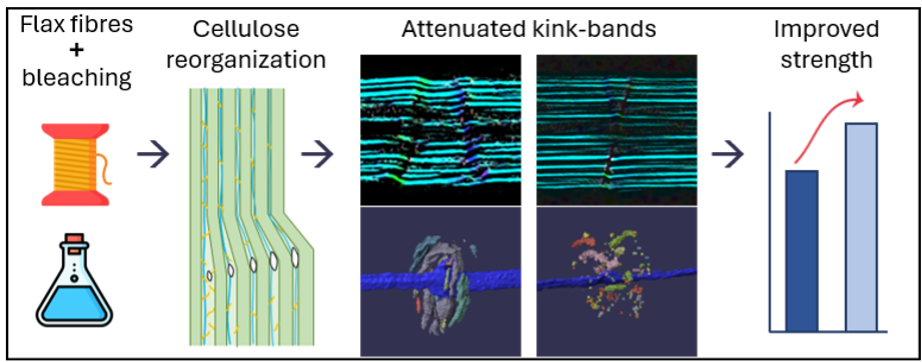
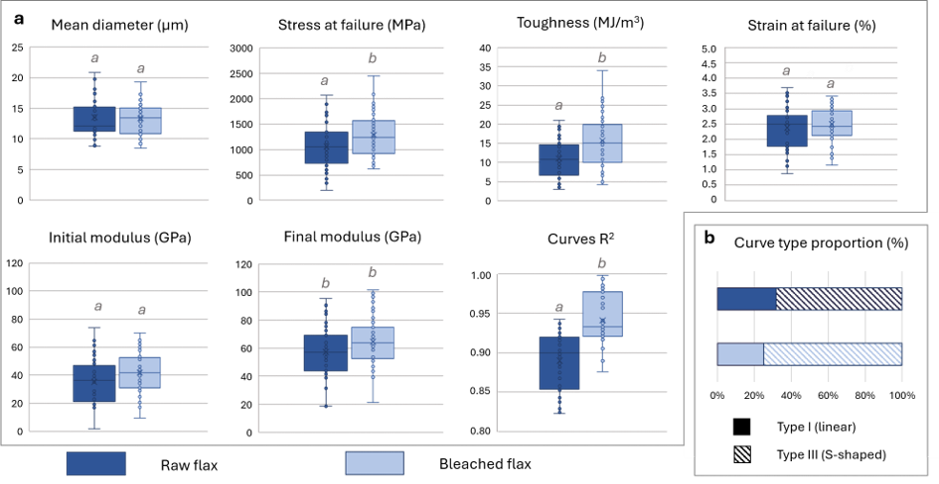
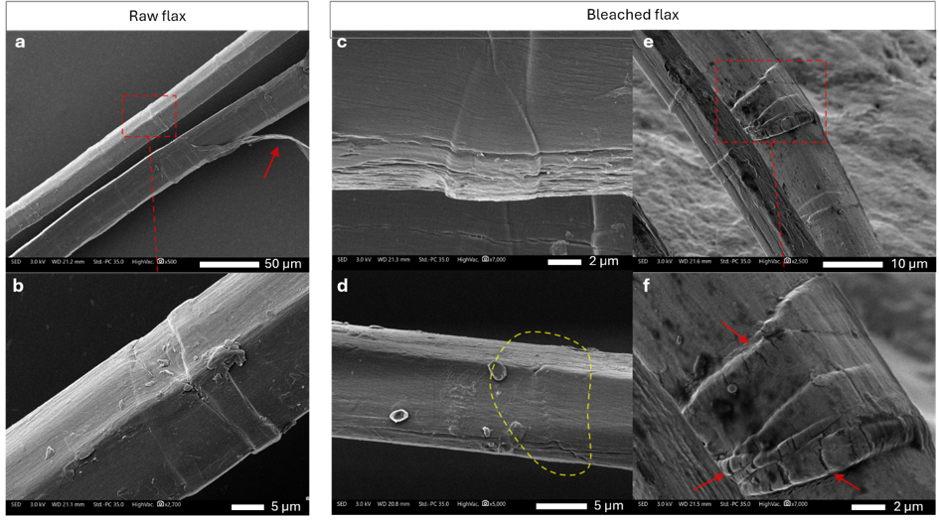
Bleached flax fibres exhibited a 21,5% increase in tensile strength compared with untreated fibres. At first glance, this result seemed contradictory. SEM observations showed that bleaching creates small areas of surface damage, particularly around naturally occuring defects known as kink bands, which are typically associated with fibre weakening.
What happens inside the fibre?
To understand why performance impreved despite visible surface damage, researchers looked deeper into the fibre structure.
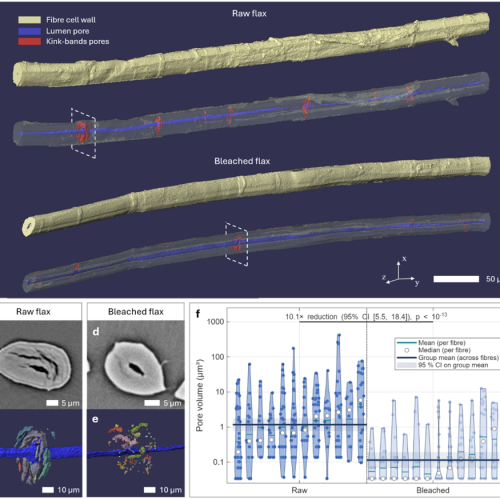
Using synchrotron X-ray microtomography, they discovered that bleaching dramatically reduced microscopic pores located within kink-band defects. In some areas, porosity was reduced by nearly and order of magnitude.
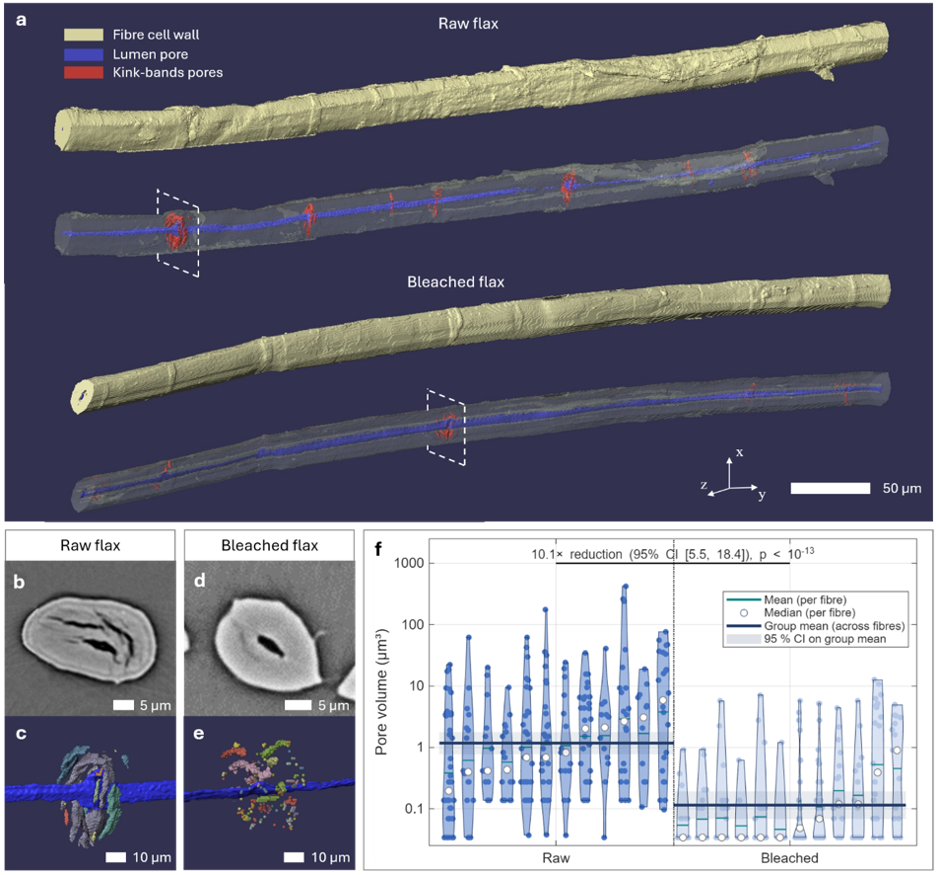
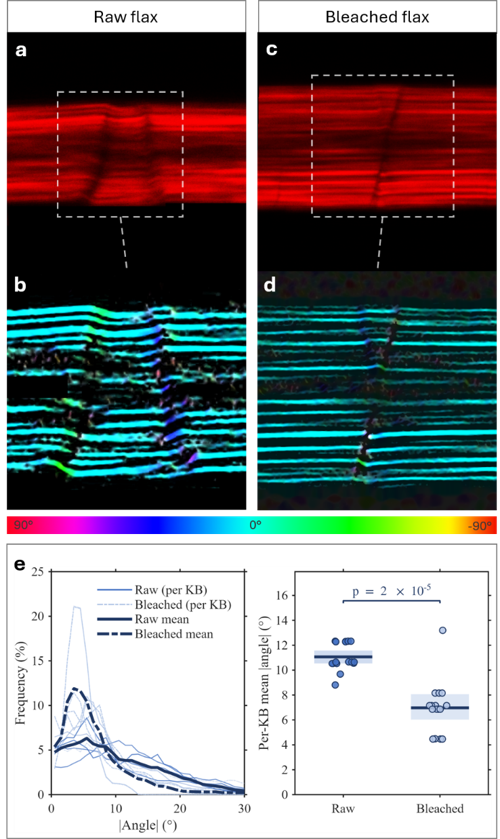
Further analyses using Second Harmonic Generation microscopy showed that cellulose microfibrils became significantly better aligned after bleaching.
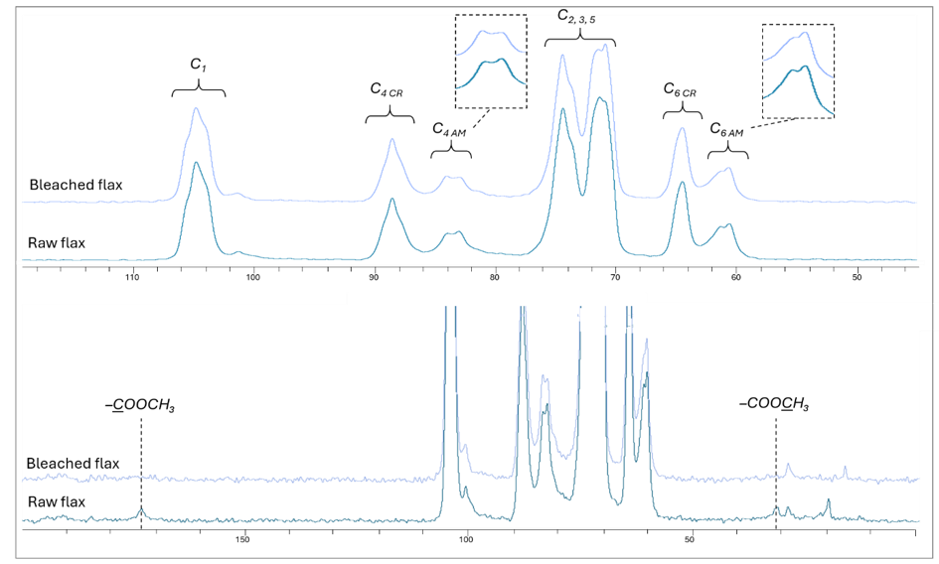
Finally, NMR analyses revealed a reduction in non-cellulosic compounds such as pectins, suggesting that bleaching promotes a reorganisation of cellulose towards a more stable structure.
Together, these changes help ewplain why fibre strength increases despite localised surface alterations.
Understanding a possible repair mechanism
The researchers propose that the bleaching treatment may trigger a reorganisation of cellulose structures within the fibre cell wall.
This mechanism could partially heal the internal consequences of kink-band defects by reducing porosity and improving microfibril alignment, ultimately leading to better mechanical performance.
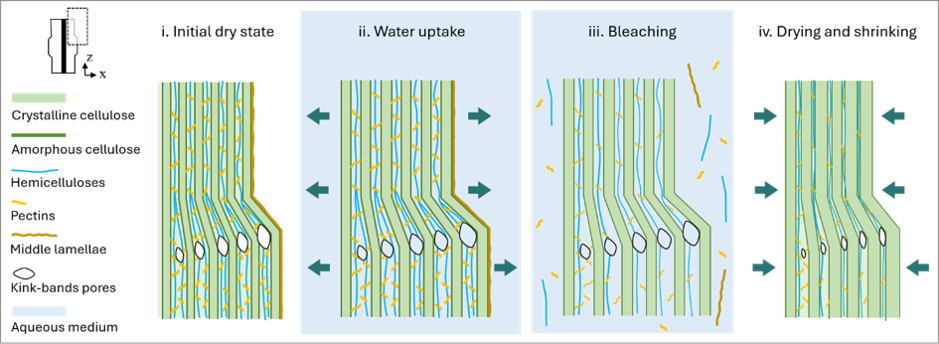
While further investigation is still needed, thses findings provide news insights into how fibre treatments can influence flax performance at multiple scales.
Advancing sustainable bio-based textiles
Beyond imporving scientific understanding of flax fibres, this work directly supports the obejctives of UPWEARS.
By identifying the mechanisms through which bleaching affects fibre performance, researchers can now better evaluate and optimize the sustainable bleaching process being developed within the project.
The ultimate goal is to create a greener treatment capable of enhancing fibre quality while reducing environmental impacts, contributing to the production of next-generation bio-absed textiles for clothing and technical applications.
Publication details
Title: Unveiling the impact of chemical bleaching on flax fibres: from cellulose reorganisation to mechanical performance
Journal: Composites Part A: Applied Science and Manufacturing
Authors: Delphine Quereilhac, Alessia Melelli, Mario Scheel, Jonathan Perrin, Xavier Falourd, Jason Govilas, Alain Bourmaud
Read the full article: https://www.sciencedirect.com/science/article/abs/pii/S1359835X26004100