What if the future of sportswear was already designed millions of years ago by nature?
The UPWEARS suit aims for multi-functionality: breathability, heat management, waterproofness, impact absorption, bioluminescence. All this should be made of biodegradable, biobased materials.
Does this sound like a revolution in the textile industry? Yes!
Is this impossible? No!
The reason to be optimistic is that it is feasible. Biological materials combine such multifunctionality on a regular basis, while staying biodegradable and using very little processing energy to be fabricated.
Needless to explain further why, in UPWEARS and in many scientific fields, Nature is the ultimate source of inspiration.
Biomimetics & bioinspiration
This has led scientists to formalize this inspiration into a methodology: biomimetics. As described by Huber & Müssig(1), Biomimetics is the « interdisciplinary cooperation of biology and technology aimed at solving technical problems through the abstraction, transfer, and application of knowledge gained from biological models ». It differs from bioinspiration, which is a more loosely-used term referring to « a method with the objective of drawing general analogies based on the study of biological systems and living organisms, which in turn are used in man-made applications and industrial challenges. ». The authors give some examples:
- Bioinspiration: a diatom is a single-cell microalgae with cell-walls arranged into intricate and aesthetically-pleasing radial patterns. A Christmas ornament can be inspired from its shape.
- Biomimetics: The diatom structure can be studied for its lightweightness as well as its ability to withstand high compressive load and absorb vibrations. The same structure can be integrated into a bike frame to improve its stiffness, and reduce its vibrations and mass, contributing to improve the performance of race bike.
Biological vs synthetic materials: two different approaches
How do biological materials combine so many functionalities at once?
Understanding the underlying mechanisms to functionality in biological materials is crucial to textile applications.
We know that it is achieved with very simple building blocks, self-assembled into structures at different length scales. In many man-made materials, traditionally, only the shape of the material itself and its composition are controlled. In contrast, in biological materials, matter is also organized in several intermediate scales. Several design parameters are thus leveraged by biological self-assembly: presence of porosity, anisotropy (different properties in different directions), micro-structural shapes and textures, and density gradients. The image below shows the universality of these principles of multi-scale hierarchy in biomaterials, from bone to silk.
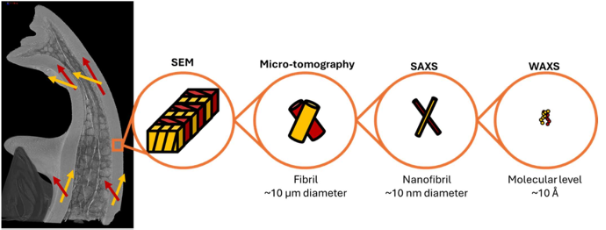
In short, as put by Vincent(2), for biological materials, material is expensive, shape is cheap. For man-made materials on the contrary, material is cheap, and so is energy – but shape is complicated to master, especially at so many different length scales.
This is why using micro-tomography and a range of other techniques is needed to probe the microstructure of these biological materials, their anisotropy, their crystallinity, etc. 3D-printing is then a great tool to reproduce these structures, and their hierarchy, as much as possible.
Biomimetics for the UPWEARS suit
Within UPWEARS, principles of biomimetics are mainly explored in Work Package 4, led by CITEVE, and bringing together textile engineers, designers and scientists from across Europe, including:
- University of Cambridge
- INRAE
- CITEVE
- University of South Brittany
- Têxteis Penedo
- PAFIL
Biomimetic research is primarily developed under Task 4.4 – Bioinspired biomimetic design for sustainable e-textiles, coordinated by the University of Cambridge. Researchers study natural systems, identify their key performance mechanisms, and translate them into textile and composite designs. These are then experimentally tested.
Three key functionalities from biological systems have come under the researchers’ scrutiny:
- Breathability
- Shock absorption
- Visibility
Breathability : let air flow in and out
- silkworm cocoons manage airflow through a fibre network that varies regionally across the cocoon, and balances permeability, humidity control, mechanical strength and thermal insulation.
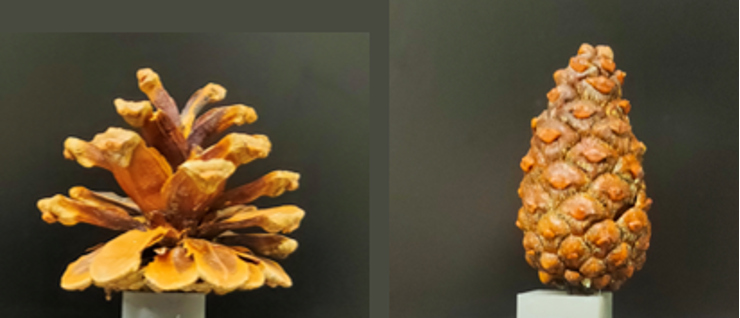
- To promote wind dispersal of their seeds, pinecones are able to protect their seeds from falling when they sense high humidity or even rain: each scale is composed of multiple layers, with a top layer that swells under humidity, causing bending of the entire scale.
Shock absorption: resist and dissipate high impact loads
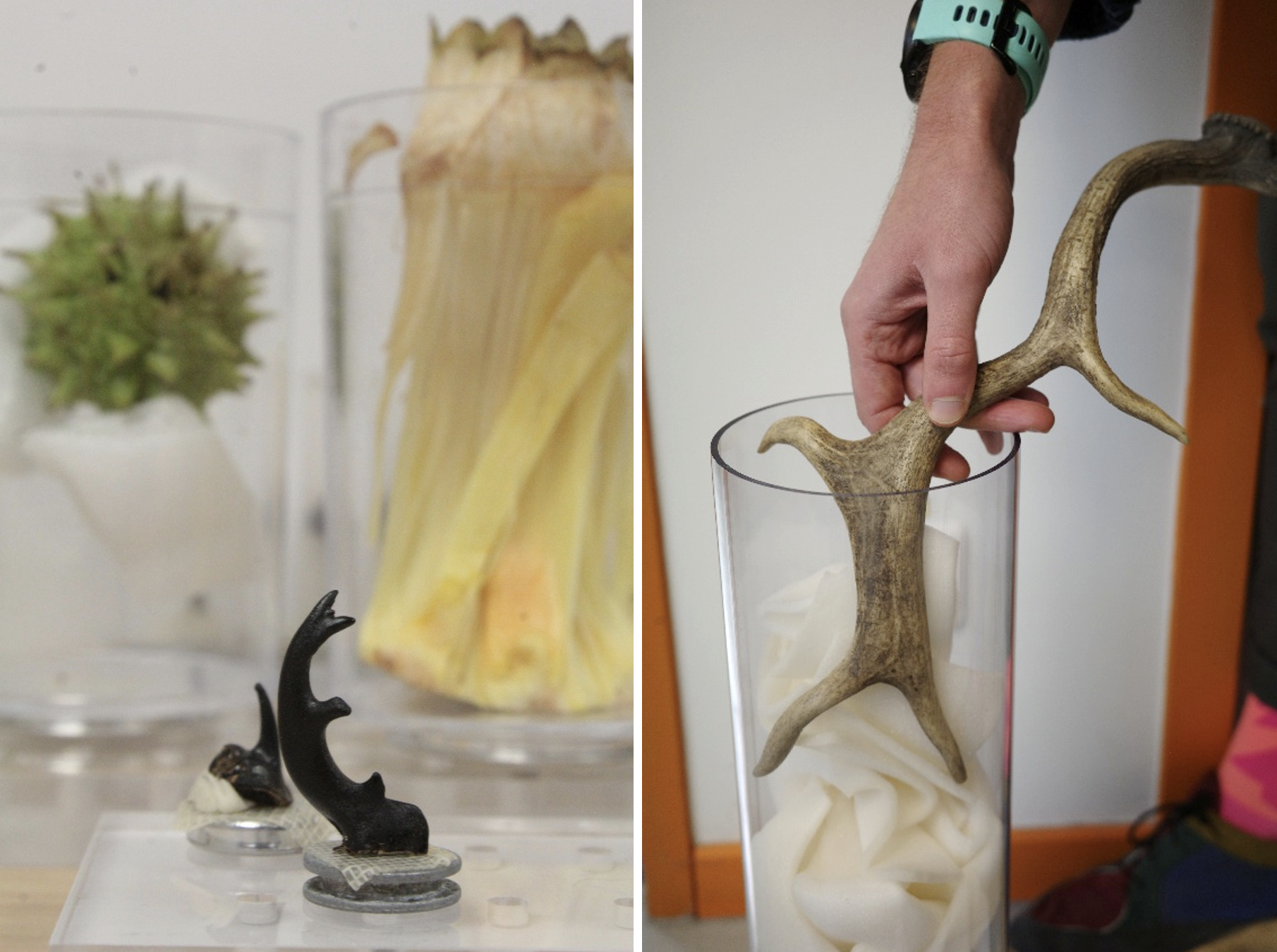
- beetle mandibles have deployed the ability to stop the propagation of a crack when it arises via a complex fibrous architecture
- This architecture is to be compared to other animal appendages such as horns or antlers used for fighting and foraging
- fruit skin of some of the largest fruits in the world, are able to protect their seeds from falls of up to 25 m, or from being crushed by an elephant masticating the fruit whole
Visibility : safety feature in dark environments
Bioluminescence is present across five out of the seven kingdoms of life: only plants and archaea do not show any species displaying this capability. Its importance in biology is highlighted by the fact that it is estimated to have evolved independently 40 different times across different phyla.(3) It has multiple uses, from camouflaging to deterring potential predators.
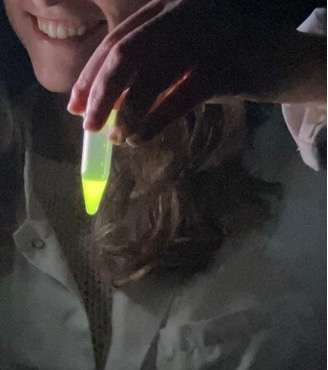
In UPWEARS, bioluminescence is being designed as a safety feature. If a cyclist falls in a low-light environment and gets separated from their bicycle, injured, they must stay visible. Rather than integrating heavy electronics, the goal is to develop lightweight, low-intensity illumination solutions aligned with sustainability objectives.
An emergency feature of the UPWEARS suit is therefore a triggerable bioluminescent pod, that displays several hours’ worth of lighting, using firefly luciferin/luciferase compounds. Once activated, the reaction is naturally non-reversible, therefore the pods are designed to be fully compostable and replaceable.
Nature as a mentor
An argument often used to use Nature’s teachings is that the features developed by biological materials have been optimized and perfected through millions of years of evolution. Natural selection does indeed promote the « survival of the fittest ». « Fittest » means « most adapted to its environment », not the best-performing for a specific function! Anyone wishing to apply the biomimetics method should always keep in mind that biological materials evolve from a set of constraints that might not match ours. This being said, in biological materials, using a limited pool of resources (energy, material) is a recurring constraint, which is also shared by the UPWEARS project’s philosophy.
Applying biomimetics principles onto sustainable sportwear goes beyond technical considerations and performance. A garment is never just a piece of fabric: it carries values that transfer onto its wearer.
Within the foundations of the field of biomimetics, lies the powerful idea that the Natural world should be listened to, observed carefully, deeply respected. This same association will transfer onto the UPWEARS demonstrator: Nature should not just be around riders, but also proudly worn by them.
References
- Huber, T. &Müssig, J. Clarity Amidst Ambiguity: Towards Precise Definitions in Biological-Informed Disciplines for Enhanced Communication.Biomimetics (Basel) 10, 76 (2025).
- Vincent, J. F. V. Survival of the cheapest.Materials Today5, 28–41 (2002).
- Haddock, S. H. D., Moline, M. A. & Case, J. F. Bioluminescence in the Sea.Annu. Rev. Mar. Sci.2, 443–493 (2010).