
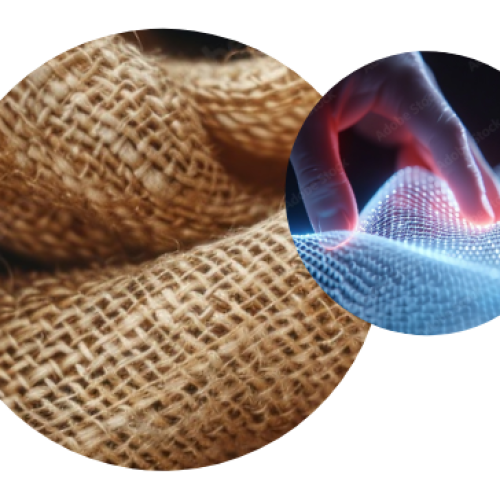
From 10 to 12 March 2026, UPWEARS will take part in JEC World 2026, showcasing its latest developments in bio-based and smart e-textiles at Hall 5, Circularity Village.
On its booth, visitors will discover a range of material, technology and characterisation demonstrators, from solvent-treated flax fibres and conductive yarns to integrated sensor-enabled textiles and advanced 3D visualisation of textile structures. Together, these demonstrators highlight the project’s systemic approach to sustainable innovation across the entire textile value chain.
Through them, UPWEARS illustrates its core objective: creating a new generation of high-performance, bio-based e-textiles.
Flexible composites from lignin – Bioeconomy Science Institute
Lignin-Based Flexible Composite Matrix for E-Textile Applications
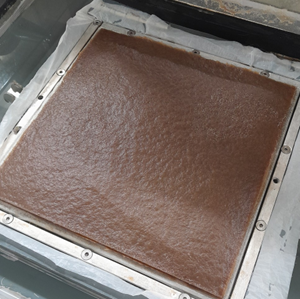
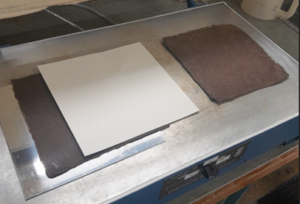
A 1-meter flexible matrix was successfully fabricated from bio-sourced materials, incorporating lignin as a functional additive. The composite demonstrates excellent flexibility and scalability, showing strong potential as a sustainable substrate for e-textile applications. When laminated onto twill fabric, it exhibited excellent adhesion and mechanical stability, with no delamination observed after washing and drying, highlighting its durability for practical wearable use.This is a fruitful collaboration between BSI (New-Zealand) and INRAE (France).
Fibres – INRAE (France), Linificio (Italy)
From Raw Flax to DES-Treated Technical Fibres
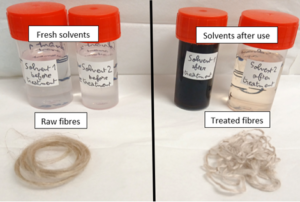
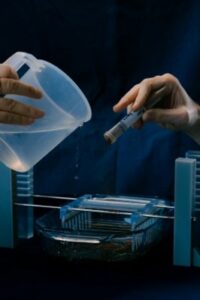
A process for degumming/bleaching flax rovings using deep eutectic solvents (DES). The degumming aspect focuses on removing non-fibrous compounds, which allows the individual fibres gathered together in bundles by these compounds to be separated. This separation makes it possible to produce a finer, higher-quality yarn from the rovings. The bleaching aspect is purely related to the textile industry, which requires white yarns so that they can be dyed in different colours.
This process is based on the use of two different DES (solvent 1 and solvent 2 in the photo) used one after the other to treat the fibres. The solvents (especially solvent 1) are rich in extracted coloured components. The scalability of the process was tested on Linificio’s facilities (Italy).
The raw fibres come from a flax stem. This flax has been retted (in the field), scutched and hackled (by the Terre de Lin cooperative) to produce a sliver. Several slivers are blended and then twisted together (by the Linificio company) to form the roving. The degummed/bleached fibres are raw fibres that have undergone a degumming/bleaching process based on the use of two DES.
Functionalised fibres – INRAE (France), BSI (New-Zealand)
Carbon-Coated Conductive Flax Yarn via Dip-Coating Process
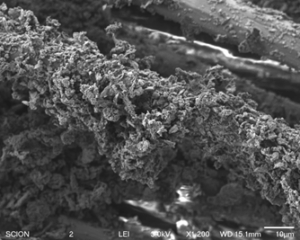
This demonstrator is about the development of conductive textile yarn using carbon derived from flax crop residues. Conductive tracks are aimed to replace metal wires in e-textiles. Through a dip-coating process, the flax yarn is coated with percolated conductive particles enabling electron transfer along the surface of the yarn fibres.
This raises technological questions related to the quality of the dip-coating process and the dispersion of particles along the yarn to obtain a continuous conductive network. The research focuses on the size and microstructure of the particles, on promoting interactions between the fibre surface and the carbon particles, and on preserving the conductive properties of the yarn during textile integration and application.
 To address these challenges, extensive resources are mobilised, including access to partner laboratories such as INRAE-BIA Nantes (France), UMR IATE Montpellier (France), CIRAD Montpellier (France), and SCION-BSI Rotorua (New Zealand). Advanced equipment is also used, including the PLANET platform (UMR IATE Montpellier, France), SEM microscopy (BIA Nantes, France and SCION-BSI Rotorua, New Zealand), micro-computed tomography (Institut Marie-Louis Pasteur Besançon, France), as well as the ESRF synchrotron in Grenoble (France) and the SOLEIL synchrotron in Gif-sur-Yvette (France).
Jacquard textile – INRAE (France), CITEVE (Portugal), Têxteis Penedo (Portugal)
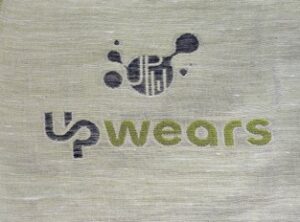
This fabric was created using Jacquard technology, which allows each warp thread to be customized. In the UPWEARS project, Jacquard will enable us to obtain fabrics with multiple properties localized according to the needs of the human body: breathability under the arms, stretchability at the elbows, etc.
This fabric is made entirely from natural fibers, is easily recyclable, and requires less water and energy to produce. This is a fruitful collaboration between INRAE (France), CITEVE (Portugal) and TPenedo (Portugal).
Sensor – Université Marie & Louis Pasteur
Flax Yarn-Based Gas Sensor with Integrated Visual Feedback
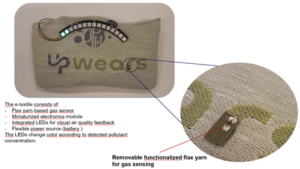
The e-textile consists of a flax yarn-based gas sensor combined with a miniaturized electronics module. It also integrates LEDs that provide visual air quality feedback, as well as a flexible power source (battery).
The LEDs change color according to the detected pollutant concentration. This is a fruitful collaboration between UMLP (France), BSI (New-Zealand), INRAE (France).
3D Yarn Tomography Models – Microstructural Visualisation of Textile Yarns – Université Marie et Louis Pasteur & Têxteis Penedo
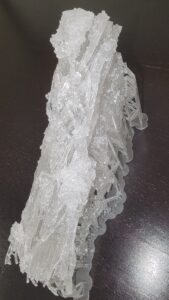
This demonstrator presents two 3D-printed models of textile yarns whose geometry was reconstructed using micro-computed tomography. The yarns are made of Tencel (regenerated cellulose fibres), with one sample coated with cork and the other left uncoated.
The models illustrate how tomography can reveal the internal structure and morphology of textile yarns at high resolution. By translating these scans into enlarged 3D-printed objects, the demonstrator makes it possible to visualise fibre organisation, porosity and structural variations that are normally invisible to the naked eye.
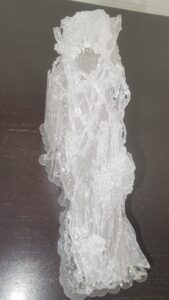
The comparison between the two yarns highlights the morphological changes induced by the cork coating process and provides insights into how such functional coatings interact with the yarn structure. Beyond its educational value, this approach supports research on material functionalisation and helps better understand the relationship between fibre architecture, coating techniques and final textile performance.
📍 Meet the UPWEARS consortium at JEC World 2026 – Hall 5, Circularity Village
Discover how bio-based smart e-textiles are paving the way for the next generation of sustainable sportswear!